




INTRODUCTION
Microsoft (NASDAQ: MSFT) enters 2026 at a fascinating crossroads. Despite delivering record revenue numbers throughout 2025, the stock has essentially trailed the broader market, posting a roughly 16% gain against the S&P 500’s 18%. For a company that effectively kicked off the generative AI revolution, this underperformance confuses many retail investors.
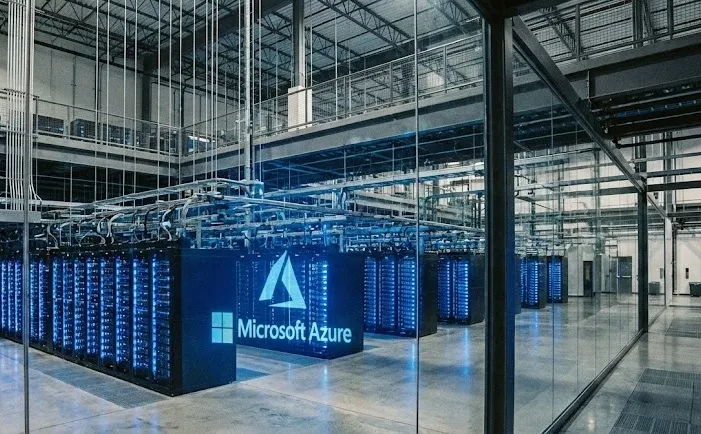
The disconnect comes down to one word: Capital Expenditure (Capex). Wall Street is currently wrestling with the sheer scale of Microsoft’s spending—over $30 billion in a single quarter—to build out AI infrastructure. While the revenue from Azure and Copilot is real and growing, the profit margins are under temporary pressure. This analysis looks past the headlines to evaluate the restructured OpenAI partnership, the actual ROI on AI spending, and what realistic price targets look like for the next 12 months.
The 2025 Performance Paradox
2025 was a “show me the money” year for AI. While Microsoft proved it could generate revenue—with Azure growing at a consistent 33-34% clip—the stock price suffered from “capex fatigue.” Investors grew wary as the company signaled that infrastructure spending would continue to rise well into fiscal year 2026.
However, context is vital here. Microsoft isn’t burning cash on speculative R&D; it is building tangible assets (data centers and GPU clusters) that are supply-constrained. The backlog of demand for Azure AI services suggests that if Microsoft could build faster, it would earn more. The stock’s consolidation in the $480-$490 range likely represents a base-building phase before the market fully digests the long-term cash flow potential of these assets.
The OpenAI Restructuring: A $135 Billion Anchor
Late 2025 brought clarity to the confusing relationship between Microsoft and OpenAI. The restructuring of OpenAI into a Public Benefit Corporation (PBC), with Microsoft securing a formal ~27% equity stake, effectively creates a massive asset on Microsoft’s balance sheet.
Valued at approximately $135 billion, this stake isn’t just paper money. The new agreement includes a massive $250 billion commitment from OpenAI to use Azure services over the next few years. This turns Microsoft’s investment directly back into high-margin cloud revenue. The fear of an OpenAI “breakup” has been largely neutralized, securing Microsoft’s IP rights to GPT-4 and future models until at least 2032. This was the certainty institutional investors needed.
Azure vs. The Field: Is the Moat Widening?
While Google and Amazon are formidable, Microsoft’s integration of AI into the enterprise stack (Office 365 + Azure) remains its strongest moat. The numbers support this:
- Azure AI Growth: AI services alone contributed roughly 12-15 points to Azure’s overall growth in late 2025.
- Copilot Adoption: While seat adoption is slower than the hype suggested, it is sticky. Once a legal or coding team integrates Copilot, they rarely churn.
The concern for 2026 isn’t demand; it’s margin compression. Building AI factories is expensive. Gross margins for the Microsoft Cloud segment have dipped slightly, but management expects these to normalize as the infrastructure scales.
Valuation and 2026 Outlook
Trading at a forward P/E of roughly 31x, MSFT is not “cheap” by historical standards, but it commands a premium for safety and consistency.
Most analysts have set price targets for 2026 in the $560 to $625 range. This implies a potential upside of 15-25% from current levels. The bull case relies on earnings per share (EPS) growing faster than revenue as the heavy capex cycle peaks and efficiency gains kick in. If the company hits its fiscal 2026 earnings estimates of ~$15.75 per share, the current valuation is justifiable.
PRACTICAL INSIGHTS
- Ignore the “AI Bubble” Noise: Distinguish between companies selling AI dreams and companies selling AI infrastructure. Microsoft is selling the picks and shovels (Azure) and the gold (Copilot).
- Watch the Operating Margins: In the next two earnings calls, focus less on revenue growth and more on operating margins. If margins stabilize despite high capex, the stock will likely break out to new highs.
- Dividend Growth: Microsoft is on the verge of becoming a Dividend Aristocrat. While the yield (~0.7%) is low, the safety of that dividend is unmatched. It serves as a decent buffer during volatility.
- Entry Strategy: The stock has strong support near the 200-day moving average (around $460-$470). Any dip to these levels due to broader market fear is historically a strong buying opportunity.
FAQs
Is Microsoft stock overvalued at current levels? At roughly 31x forward earnings, it trades at a premium to the S&P 500 (approx. 21x). However, given its dominant position in cloud computing and AI, along with an AAA credit rating, this premium is generally considered warranted by institutional investors.
How does the OpenAI partnership actually make money for Microsoft? It works in two ways: 1) Microsoft owns ~27% of OpenAI, so as OpenAI’s value grows, Microsoft’s assets grow. 2) OpenAI pays Microsoft billions of dollars to run its models on Azure servers, generating direct cloud revenue.
Will AI spending hurt Microsoft’s profits in 2026? It will likely suppress margin expansion temporarily. The company is spending heavily now to secure future dominance. Profits will grow, but perhaps not as fast as revenue until the infrastructure build-out stabilizes.
How does Microsoft compare to Nvidia as an AI investment? Nvidia is a hardware play; Microsoft is a software and infrastructure play. Nvidia has higher growth potential but higher volatility. Microsoft offers more stability and a diversified business model (gaming, LinkedIn, Windows) beyond just AI chips.
CONCLUSION
Microsoft remains the “adult in the room” for AI investing. The euphoria of 2023 and 2024 has settled into a phase of execution and infrastructure building. While the massive capital expenditures in late 2025 scared off some short-term traders, the restructuring of the OpenAI deal and the sustained demand for Azure provide a solid foundation for 2026. For investors with a time horizon longer than a few quarters, the current consolidation offers a reasonable entry point into a company that is effectively building the utility grid of the future economy.





Leave a Reply