




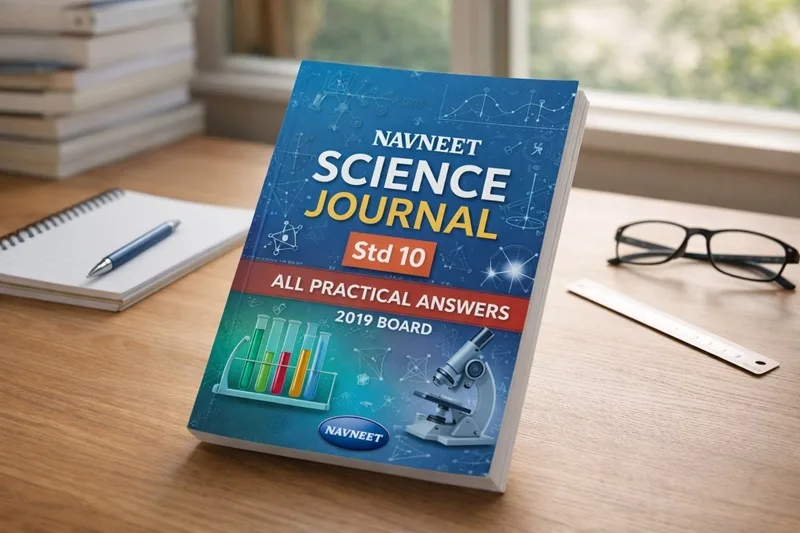
10 t h Grade Science The 10th grade is the core of our high school program. It demands not just rote memorization of theories, but a grasp on how those theories work themselves out in the messy world. This is where practicals enter the picture. The Navneet Science Journal has always been popular among the students of Maharashtra and its neighboring states. It’s a complete journal tracking your experiments, observations and conclusions — an indispensable part of the board curriculum.
The Navneet Science Journal of Standard 10 (2019) is especially important. Although the syllabi change, the fundamental principles of science do not. The experiments described on this website offer students an introduction that is easy to understand and yet scientifically correct for high-usability Physics, Chemistry and Biology learning. So whether you already know that you’re right or you are trying to understand how a problem was solved in detail, this is going to be a resource that’s very valuable.
This book explains all the practical activities from the 2019 paper, breaking them down into easy-to-understand segments and providing expert advice on acing your exams.
Summary of the 2019 Science Practicals
The 2019 board syllabus of Standard 10 Science was set such as to check how much an examinee could observe and analyze. The practicals are usually structured into two parts: One (Physics and Chemistry) and Two (Biology and Environmental Science).
In Part I, there tends to be an emphasis on testing laws, apprehending chemical reactions and investigating the nature of light and electricity. Perhaps you will come across experiments on Ohm’s law, refraction through glass slabs or investigation of chemical reactions like saponification.
Moving on to Part II, it focuses and describes the living world. The living world often takes students to see the slides of microorganisms, study the reproductive organs of the flowers, our analyse the environmental conditions. For the same year of 2019, the Navneet Journal stresses the drawing of a correct diagram and the exact writing of the recordings of observation.
According to the structure of the Navneet Journal, you usually need to fill in the following script:
- Aim: Assumption of the experiment and proof
- Apparatus/Chemicals: Materials required for the test
- Procedure: The method is conducted in four simple steps
- Observation: The data or columns of information
- Inference/Conclusion: The drawing of the conclusion from the experiment conducted
Key experiments and their results For a better understanding of how to approach the answer, let us take into consideration certain examples found in the 2019 journal.
Physics: Refraction of light through a glass slab
Aim – You can see the path of a ray of light that passes through a rectangular glass slab. Measure the angle of incidence and the angle of emergence Observation For instance, you can witness that the ray that emerges come out as parallel to the incident ray but laterally displaced.
Answer – In the conclusion, you state that angle i is almost equal to e. This implies that the ray bends towards the normal while entering the glass and is away from the normal when it exits.
Chemistry: Study of saponification
Aim: Study the reaction of the saponification.
Observation: Eventually, the mixture will turn into a thick paste. When tested with the acid red litmus paper, it caused blue color, proving the basic nature of soap.
Answer: in Conclusion, you state that soap is the sodium salt of long-chain fatty acids sage produced by hydrolysis of oil with an alkali.
Biology: Study of binary fission in Amoeba
Aim: Observe the binary fission in amoeba using the permanent slides.
Principal Observation: Observe that one cell elongates, the nucleus divides (karyokinesis), and then the cytoplasm is divided (cytokinesis).
The Answer: The implication is Amoeba reproduces asexually by simple binary fission–the parent cell splitting into two daughter cells.
Step-by-Step Guides for Complex Experiments
The operations in textbooks can sometimes seem thick. This is the streamlined version of how to approach a more difficult experiment you would typically find in the 2019 journal.
How to Find The Focal Length of a Convex Lens
A lot of students get really scared by this experiment (thanks to the optical bench and parallax error) but it’s pretty straightforward if you break it down.
- Apparatus: Convex lens mounted in a stand. Put a white cardboard screen on one side; a distant object, such as a tree or window, on the other.
- Adjust: Turn the screen back and forth until a sharp, inverted image of the distant object appears on the screen.
- Measurement: The space between the lens’ optical center and its screen is the focal length $f$.
- Repeat: Do this three times to get an average.
- Journal Entry: Record the three distances on your observation table. Calculate the mean. All you do is: “The focal length of the convex lens provided is [X]cm.”
Identifying Types of Chemical Reactions
You could be given various test tubes and asked to determine the type of reaction (Combination, Decomposition, Displacement or Double Displacement).
1. Observation is Key:
- If two things mix to form something (like burning magnesium ribbon), it’s Combination.
- If you are given that something breaks down on heating (eg ferrous sulphate), then it is Decomposition.
- If you get a highly reactive metal kicking out a less reactive metal Iron nail dipped in CuSO4 turning the solution green, it’s Displacement.
- If two solutions are mixed and one product of the reaction is a precipitate (insoluble solid) it’s usually Double Displacement.
2. Answer the following: Always write the balanced chemical equation to justify your answer in your journal.
Passing Your Practical Exam With Flying Colors
Another thing to write in the journal is quite another to perform under exam pressure. Here’s what you can do to make sure you earn that ideal score.
- Be Neat: Navneet book is given grades. Make sure that your alternative paper has clear handwriting and that diagrams are drawn with a well-sharpened pencil! Naming is essential in Bio drawings.
- Learn the “Why”: You do not just memorize the off-the-cuff response. Viva voce examiners often ask for the viva (Latin for “with living voice”; not limited to singing). If you knew why litmus turned blue, then you can respond with confidence.
- Note to self: Input the units in Physics Otherwise, loss of marks by not posting ‘cm’, ‘m’, ‘A’ or ‘V’.
- Safety First: If you are asked about safety precautions (eg “handle acid with care”) always say it, both in viva and written scheme. It proves you are a conscientious student.
Why Practical Knowledge Matters
It can be all too tempting to see the science journal as just another piece of work to finish and forget about. But practicles are the fancy that links theory up into Reality.
Once you wire things up, and see Ohm’s Law in action, you have a visceral understanding of resistance that no “textbook” definition can impart. When you see a slide of a hydra budding, it’s pretty easy to remember life cycles. Doing so enhances the ability to think critically and solve problems. It teaches you to doubt, hypothesize, test empirically and validate — which are not just important in science but also for navigating the world logically.
Resources for Further Study
Stuck on a certain clue for the 2019 journal, or just want some more practice?
- Maharasthra State Board Textbook (Std 10): The Holy Grail. You can derive all practicals from the ideas here.
- Online Video Tutorials: There are channels available on YouTube for Maharashtra Board practicals, where teachers perform the experiments live.
- NCERT Science Exemplars: For a different board but core experiments are quite same, good problems for practice.
- Previous Year Question Papers: Search for practical exam questions asked from 2018 – 2020 to figure out the common topics.
Mastering the Lab
The Navneet Science Journal for Standard 10 is more than just practicing filling in the blanks. It is “captain’s log” for your science education covering the school year. Learning the core experiments from the 2019 biology curriculum—from how light refracts to reproducing simple organisms—you create a base for your further studies.
Use it to check your answers, but also try and get the reason behind each observation. After all, you’re not a child anymore and science is best learnt by doing things. Anyway, let’s begin our journey: grab your book, look at your observations and step into the practical exam with true attack.





Leave a Reply