




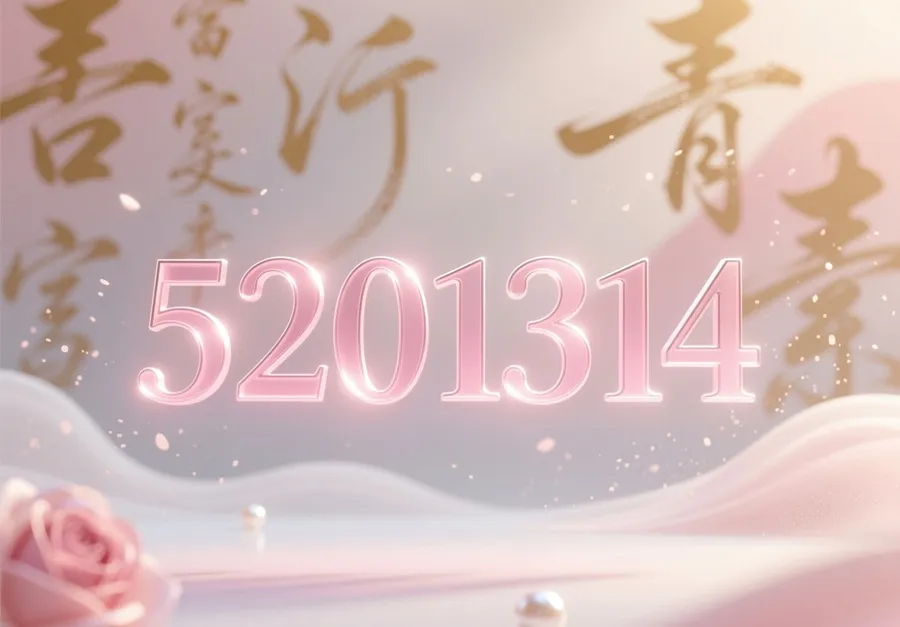
If you’ve spent even a little time on Asian social media, especially Chinese or pan-Asian pop-culture spaces, you’ve probably stumbled upon the mysterious number 5201314. It pops up in comments, captions, couple posts, wedding videos, and even in online gaming chats.
At first glance, it looks like a random line of digits. But behind it lives one of the internet’s most romantic love codes ever created.
And the deeper you look, the more fascinating the story becomes — blending language, culture, internet evolution, and real-life relationships.
Let’s break down the true meaning of 5201314, why it went viral, and how people actually use it in 2025.
What 5201314 Actually Means
The number 5201314 is a Chinese love phrase written through numbers. When read out loud in Mandarin, each section sounds like a meaningful sentence:
| Number | Pronunciation | Sounds Like | Meaning |
|---|---|---|---|
| 520 | wǔ èr líng | wǒ ài nǐ | “I love you” |
| 1314 | yī sān yī sì | yī shēng yī shì | “For a lifetime / forever” |
Put them together and the entire sequence 5201314 translates to:
“I love you for a lifetime.”
It’s poetic, simple, and incredibly emotional — which explains why it became China’s unofficial digital love language.
How 5201314 Became an Internet Sensation
5201314 didn’t go viral overnight. Its rise was a combination of:
1. The Chinese habit of turning numbers into words
Mandarin has many sound-alike numbers. For example:
-
520 → I love you
-
1314 → Forever
-
88 → Bye bye
-
233 → Laughing hard
Internet users began playing with these combinations in the early 2000s when text messaging was expensive. Using numbers was cheaper — and more fun.
2. Social media gave it wings
Platforms like Weibo, QQ, TikTok (Douyin), and WeChat made the number format explode. Influencers began posting romantic content with the caption “5201314”.
It quickly became a cultural symbol of digital love, almost like saying “forever yours” with a modern twist.
3. The date 5/20 became “Internet Valentine’s Day”
Since 520 means “I love you,” the date May 20 (5/20) is celebrated like an unofficial Valentine’s Day in China.
Couples exchange gifts, propose, share confessions — and yes, post 5201314 everywhere.
Why 5201314 Feels So Emotionally Powerful
5201314 isn’t just a meme. It carries emotional depth that resonates across cultures.
1. It’s intimate and coded
You’re not just saying “I love you.”
You’re saying:
“I love you forever, in a secret code only we understand.”
That insider feeling makes it special for couples.
2. It blends language, creativity, and emotion
Love messages are universal. But turning them into numbers adds novelty. It feels playful yet meaningful — the perfect formula for viral content.
3. It’s used during major life events
Examples include:
-
A boyfriend engraving 5201314 on a ring.
-
Couples printing it on wedding invitations.
-
Gamers using it as in-game usernames.
-
Teens sending it secretly to someone they like.
A reader once shared how her fiancé proposed by giving her a bracelet engraved with “5201314.” She didn’t understand it immediately — but once she did, she said it meant more than a thousand roses. That’s the emotional power behind these numbers.
Where You’ll Commonly See 5201314 Used Today
In 2025, 5201314 shows up in many digital and real-world spaces:
1. Social Media Captions
Couples post it under photos, especially on 5/20 and anniversaries.
2. Text Messages & DMs
Instead of saying “Love you,” people simply type “5201314 ❤️”.
3. Gifts & Engravings
Jewelry with 5201314 has become a popular trend among young Asian couples.
4. Wedding Themes
Brides and grooms add the number to décor, hashtags, and even vow books.
5. Online Gaming & Usernames
You’ll find players naming accounts like “5201314baby” — especially on Asian servers.
520 vs. 5201314 — What’s the Difference?
Many users confuse the two, so here’s the simple breakdown:
520 (I love you)
A casual, sweet confession.
Used like:
-
texting your partner
-
posting on 5/20
-
flirting subtly
5201314 (I love you forever)
A commitment message.
Carries deeper meaning and often symbolizes long-term love.
You can think of it like:
-
520 → “I love you”
-
5201314 → “I want a future with you”
Fun Variations of Love Number Codes
Chinese netizens have created many numeric expressions:
-
1314 → Forever
-
921 → Just love you
-
7998 → Say you love me
-
880 → Hug you
-
9420 → Love you forever
But none are as iconic or widely recognized as 5201314.
Real-World Example: How Someone Might Use It
Imagine this scenario:
Your partner posts a photo of both of you at a sunset point. Instead of writing a long caption, they simply write:
“5201314 ❤️✨”
Anyone aware of the meaning instantly understands:
“They’re saying I love you forever — publicly.”
It’s simple yet emotionally loaded.
Is 5201314 Only for Romantic Love?
Not necessarily.
Some people use it for:
-
Best friends
-
Parents
-
Siblings
-
Mentors
-
Long-term partners (married or not)
However, the tone is still deeply emotional, so most people reserve it for strong, lifelong bonds.
Cultural Insight: Why Numbers Work So Well in Chinese
Mandarin has many homophones, and number-slang takes advantage of that.
This linguistic flexibility makes China’s internet culture uniquely rich with code words, emojis, and number letters.
It’s similar to how English speakers use:
-
143 → I love you
-
831 → I love you (8 letters, 3 words, 1 meaning)
But Mandarin versions often sound closer to actual spoken phrases, making them feel more natural.





Leave a Reply