




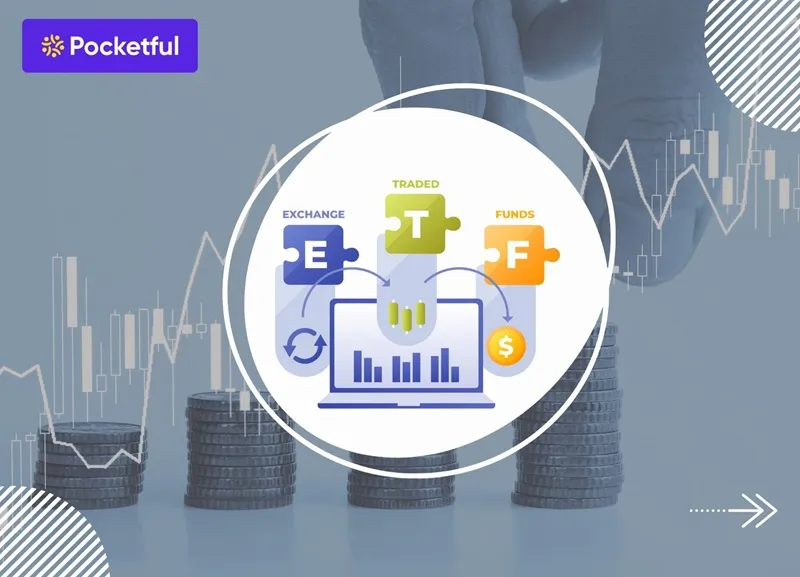
One of the most persistent myths about stock market investing is that you need large capital to get meaningful results. The reality is quite different. Some of the most effective long-term investment strategies are built around consistent, disciplined investments of modest amounts — and Exchange Traded Funds are at the centre of that approach.
ETFs combine the diversification of a mutual fund with the trading flexibility of a stock. They track an index, sector, commodity, or asset class and can be bought and sold on the exchange at real-time market prices during trading hours. For retail investors across India, they offer a transparent, cost-efficient, and flexible way to build long-term wealth.
Whether you are a salaried professional investing Rs 2,000 a month or someone sitting on a lump sum looking for deployment options, ETFs deserve serious consideration as a core component of your portfolio.
Why ETFs Work So Well for Long-Term Investors
ETFs have several structural advantages that make them particularly well-suited for retail investors building wealth over time:
- Low expense ratios: Index ETFs in India typically charge 0.05% to 0.20% per annum — far lower than actively managed funds
- Diversification in a single trade: A Nifty 50 ETF gives you exposure to 50 companies across sectors instantly
- Intraday liquidity: Unlike mutual funds priced once a day, ETFs can be bought and sold anytime during market hours
- Transparency: ETF holdings are disclosed daily — you always know exactly what you own
- Tax efficiency: ETFs held for more than one year qualify for long-term capital gains treatment
When you Invest in ETFs with Pocketful, you get access to a curated selection of equity, debt, gold, and international ETFs with seamless execution and real-time portfolio tracking.
Types of ETFs Available in India
Equity ETFs
Track major indices like Nifty 50, Sensex, Nifty Next 50, Nifty Midcap 150, and sectoral indices like Bank Nifty, IT, and Pharma. Ideal for core long-term equity allocation.
Gold ETFs
Track domestic gold prices. Each unit represents approximately 1 gram of gold. Cost-efficient alternative to physical gold without storage or purity concerns.
International ETFs
Provide exposure to global markets — US equities via S&P 500 tracking funds, Nasdaq 100, or specific country-focused ETFs. Useful for geographic diversification and currency hedging.
Debt ETFs
Track government securities or bond indices. Lower risk than equity, higher returns than savings accounts. Increasingly popular as a debt allocation tool for retail investors.
Best Debt ETFs for Stable Returns
For investors who want steady, predictable returns without equity market volatility, the Best Debt ETFs in India offer a compelling option. They provide returns tied to government security yields — typically higher than FD rates for equivalent durations — with the added benefit of daily liquidity on the exchange.
Key categories of debt ETFs include:
- Liquid ETFs: Short-duration government securities; suitable as a cash management tool
- Gilt ETFs: Long-duration government bonds; ideal for rate cut cycles
- Target Maturity ETFs: Fixed maturity structure with predictable yield-to-maturity
- Corporate Bond ETFs: Higher yield than gilt ETFs with moderate credit risk
How to Build an ETF Portfolio Step by Step
Building an ETF portfolio is straightforward. Here is a practical framework:
| Step | Action |
| 1. Define Goals | Retirement, education, home — set clear targets with timelines |
| 2. Asset Allocation | Decide equity vs debt vs gold split based on risk appetite |
| 3. Select ETFs | Choose low-cost, high-liquidity ETFs for each asset class |
| 4. Invest Regularly | Use SIP in ETFs or invest lump sums systematically |
| 5. Review Annually | Rebalance to maintain target allocation as markets move |
Common ETF Investment Mistakes to Avoid
- Choosing ETFs with low liquidity — wide bid-ask spreads increase actual cost significantly
- Ignoring tracking error — a high tracking error means the ETF does not accurately mirror its index
- Over-diversifying with too many ETFs — 4 to 6 core ETFs covering equity, debt, and gold are sufficient for most retail investors
- Timing the market — ETFs work best with consistent, long-term investing rather than short-term trading
Small Investments, Large Outcomes
The power of ETF investing lies in consistency, not the size of individual contributions. A systematic Rs 5,000 monthly investment in a Nifty 50 ETF over 20 years at 12% annualised returns builds a corpus of approximately Rs 49 lakh. At Rs 10,000 monthly, that becomes Rs 98 lakh.
The numbers are not magical — they are simply what happens when you invest consistently in a low-cost, diversified product over time. ETFs are the vehicle that makes this accessible to every investor in India, regardless of their starting capital. Begin with what you have, stay consistent, and let the markets do the rest.





Leave a Reply