
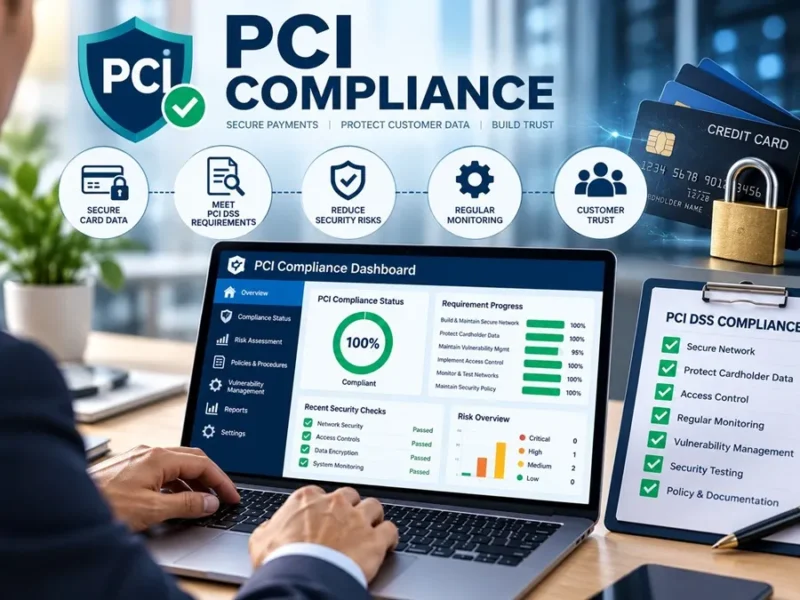



PCI compliance is essential for businesses that store, process, or transmit payment card data. Following the Payment Card Industry Data Security Standard (PCI DSS) helps organizations protect cardholder information, reduce security risks, and maintain secure payment environments. However, many businesses make avoidable mistakes, such as overlooking payment systems, misconfiguring access controls, neglecting security updates, and failing to maintain proper documentation.
These mistakes can expose sensitive payment information and make it harder for organizations to demonstrate compliance. Understanding common PCI DSS compliance gaps and addressing them early can help businesses strengthen payment security while reducing operational and financial risks.
What Is PCI DSS Compliance?
PCI DSS is a security standard developed by the Payment Card Industry Security Standards Council (PCI SSC) to protect payment account data. It applies to organizations involved in storing, processing, or transmitting payment card data, as well as other entities whose systems can affect the security of the cardholder data environment.
The standard establishes requirements for areas such as network security, access management, vulnerability management, logging, testing, and information security policies.
PCI DSS v4.0.1 is the current published version of the standard as of October 2026. Businesses should verify the applicable requirements and validation process with their acquiring bank, payment brands, or qualified assessor.
PCI compliance is not simply a certification exercise. It requires organizations to maintain security controls and verify that they continue to work effectively.
Why Do Businesses Struggle With PCI Compliance?
PCI DSS compliance can become challenging when businesses use multiple payment channels, cloud services, third-party vendors, and legacy applications.
Different teams may manage payment infrastructure, cybersecurity, application development, and compliance documentation. Without clear ownership, important security requirements can be overlooked.
Common problems include incomplete inventories of payment systems, weak authentication, outdated software, insufficient monitoring, and inconsistent employee training.
Addressing these weaknesses requires a structured approach that combines technical controls, documented processes, and regular reviews.
7 Common PCI DSS Compliance Mistakes and How to Avoid Them
1. Failing to Identify the Entire Cardholder Data Environment
One of the most common PCI compliance mistakes is failing to identify every system that stores, processes, or transmits payment card data.
Businesses sometimes focus only on their payment gateway or transaction database while overlooking connected applications, backup systems, administrative interfaces, and other components that can affect payment security.
An incomplete inventory can result in systems being excluded from security assessments even when they fall within the relevant compliance scope.
How to avoid it: Create and regularly update an inventory of payment systems, applications, network connections, data flows, and relevant third-party services. Map where payment information enters, moves through, and leaves the organization. Use network segmentation where appropriate to reduce unnecessary connections to the cardholder data environment.
2. Storing Sensitive Authentication Data Improperly
Another serious mistake is retaining sensitive authentication data after authorization when PCI DSS prohibits its storage. This can include full track data, card verification codes, and PIN data.
Businesses may unintentionally retain this information in application logs, transaction records, debugging files, or backups.
Even when data is encrypted, encryption does not make prohibited post-authorization storage acceptable.
How to avoid it: Review payment applications, databases, logs, and backup processes to identify sensitive authentication data. Configure systems to prevent prohibited storage and remove unauthorized copies. Retain only the payment account data that is permitted and necessary, following applicable requirements.
3. Using Weak Access Controls and Authentication
Poor access management can allow unauthorized users to access payment systems or sensitive cardholder data.
Common mistakes include shared administrator accounts, excessive user permissions, weak passwords, inactive accounts that remain enabled, and missing multifactor authentication where required.
These weaknesses increase the risk of account compromise and make it difficult to determine who performed a particular action.
How to avoid it: Apply the principle of least privilege so users receive only the access needed for their responsibilities. Use unique user accounts, strong authentication, and multifactor authentication in accordance with applicable PCI DSS requirements. Review permissions regularly and promptly remove access when employees change roles or leave the organization.
4. Neglecting Security Patches and Vulnerability Management
Outdated operating systems, payment applications, software libraries, and network devices can contain vulnerabilities that attackers may exploit.
Some organizations delay updates because they fear disrupting business operations. Others lack a documented process for identifying vulnerabilities and prioritizing remediation.
How to avoid it: Establish a vulnerability management program that includes regular scanning, risk assessment, security patching, and remediation tracking. Prioritize vulnerabilities according to severity and exposure, while following applicable PCI DSS deadlines and testing requirements. Document approved exceptions and verify that corrective actions have been completed.
5. Ignoring Logging and Security Monitoring
Security logs help organizations identify suspicious activity, investigate incidents, and establish accountability. However, businesses sometimes collect incomplete logs, fail to review alerts, or retain records without adequate protection.
Without effective monitoring, unauthorized access or changes to payment systems may remain undetected.
How to avoid it: Configure logging for relevant systems and security events. Protect logs against unauthorized modification and deletion, synchronize system clocks, and establish procedures for reviewing alerts. Use centralized monitoring tools where appropriate to identify suspicious activity and support incident investigations.
Logging should be treated as an active security control, not simply a requirement to store records.
6. Overlooking Third-Party Service Provider Risks
Businesses frequently rely on payment processors, cloud providers, software vendors, and other service providers. However, outsourcing payment processing does not automatically eliminate the organization’s PCI DSS responsibilities.
A service provider’s security failure may affect the merchant’s payment environment or compliance status.
How to avoid it: Maintain an inventory of relevant third-party service providers and document their responsibilities. Evaluate their PCI DSS status where applicable, review contractual security obligations, and monitor compliance evidence according to the relationship’s risk. Clearly define which party manages each security control and reassess providers periodically.
7. Treating PCI Compliance as a One-Time Project
Some businesses prepare for an assessment, resolve visible issues, and then allow security controls to deteriorate.
New applications, infrastructure changes, staff turnover, and evolving threats can introduce compliance gaps after an assessment has been completed.
How to avoid it: Integrate PCI compliance into routine security operations. Schedule access reviews, vulnerability assessments, configuration checks, security testing, policy reviews, and employee training as required. Track outstanding findings and assign clear owners and deadlines for remediation.
Continuous oversight helps businesses maintain their controls instead of rushing to address problems before the next assessment.
Best Practices for Maintaining PCI Compliance
Avoiding common mistakes requires a repeatable process rather than isolated security improvements.
Businesses should begin by defining the scope of their cardholder data environment and identifying applicable PCI DSS requirements. This provides a foundation for assigning responsibilities and selecting the right controls.
Next, establish documented security policies covering access management, data retention, vulnerability handling, incident response, and third-party risk management. Employees and contractors who interact with payment systems should understand their responsibilities and receive appropriate training.
Organizations should also maintain evidence of their security activities. This may include vulnerability scan results, access review records, configuration documentation, incident reports, training records, and remediation logs.
Finally, review the effectiveness of security controls regularly and reassess the environment whenever significant infrastructure or payment processing changes occur.
Expert Tip: Reduce your PCI DSS scope where feasible by using validated payment solutions that prevent your systems from directly handling cardholder data. Tokenization and properly implemented payment redirects or hosted payment pages may reduce exposure, but they do not automatically eliminate all PCI DSS responsibilities. Confirm the resulting scope with your acquirer or qualified assessor.
How Can Businesses Prepare for a PCI DSS Assessment?
Preparation should start well before the formal assessment.
First, confirm the applicable validation method and scope with the acquiring bank, payment brands, or relevant assessor. The required process can vary according to the organization’s role, transaction volume, and payment environment.
Next, review the applicable PCI DSS requirements and compare them against existing controls. Record any gaps and prioritize remediation based on risk and the requirements involved.
Test security controls before the assessment, verify that documentation is complete, and ensure that responsible teams can explain how controls operate in practice.
Businesses should also confirm that relevant service provider responsibilities are documented and that required evidence is available. If a Qualified Security Assessor (QSA) is involved, work with the assessor to resolve questions about scope and evidence requirements early.
Preparation is most effective when it reflects normal security operations rather than a temporary effort to produce assessment documents.
Conclusion
PCI compliance helps businesses protect payment card data and maintain a more secure payment environment. However, common mistakes such as incomplete scope identification, improper data storage, weak access controls, delayed security updates, insufficient monitoring, and poor vendor oversight can undermine these efforts.
Organizations can reduce these risks by maintaining an accurate inventory, enforcing appropriate security controls, monitoring system activity, managing third-party relationships, and reviewing compliance regularly.
The most effective approach is to treat PCI DSS as an ongoing security responsibility rather than a one-time assessment. By building compliance into everyday operations, businesses can improve their ability to protect payment information and respond to emerging threats.
Frequently Asked Questions
What are the most common PCI compliance mistakes?
Common mistakes include failing to identify the full cardholder data environment, retaining prohibited sensitive authentication data, using weak access controls, neglecting security patches, overlooking logging requirements, and failing to monitor third-party service providers.
Is PCI DSS compliance mandatory for businesses that accept card payments?
Organizations that store, process, or transmit payment card data generally have PCI DSS obligations. The applicable requirements and validation process depend on their role in payment processing, the relevant payment brands, and their acquiring arrangements.
What happens if a business fails to meet PCI DSS requirements?
Noncompliance can lead to additional assessments, remediation costs, contractual consequences, and potential financial penalties imposed through applicable acquiring or payment brand arrangements. A security incident may also create investigation costs, operational disruption, and reputational damage.
How often should PCI compliance be reviewed?
PCI DSS includes requirements with different frequencies, including ongoing monitoring and periodic activities. Businesses should follow the applicable assessment, scanning, testing, and review schedules rather than relying on a single annual review.
Can a small business achieve PCI compliance without a dedicated security team?
Yes. Small businesses can use suitable payment service providers, documented procedures, managed security services, and qualified external advisers to support compliance. However, they remain responsible for understanding and meeting the requirements that apply to their payment environment.
What is the difference between PCI compliance and PCI DSS?
PCI compliance is the broader concept of meeting applicable payment card industry security obligations. PCI DSS is the specific security standard that establishes requirements for protecting payment account data.






Leave a Reply