




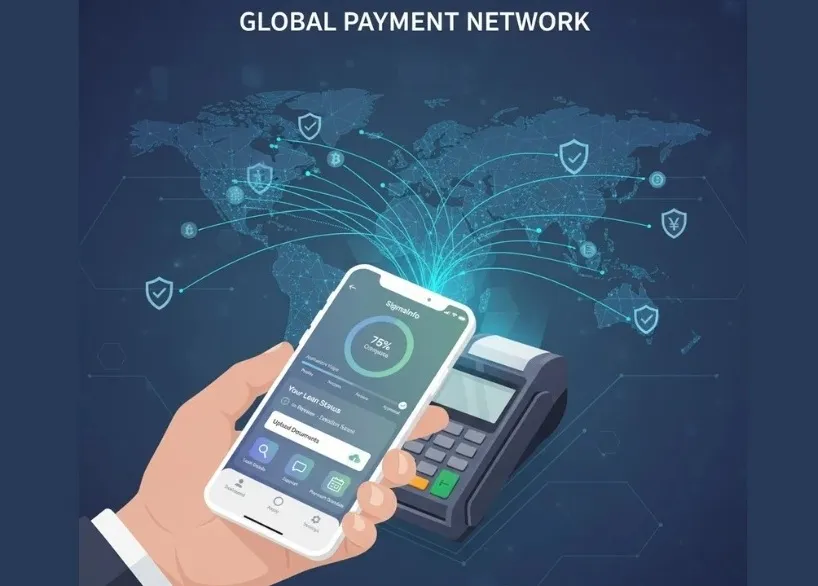
Living out a border-crossing business used to be like driving through a maze without a map. You had to put up with slow settlement times, non-transparent exchange rates, and the perpetual hassle of local compliance. But here in 2026, the global payment solutions world has changed drastically. What was a slow-motion process is becoming instantly, invisibly and vastly more secure.
Weather you’re hoping to grow your company or just stopping money from getting lost down the dark hole of hidden FX fees,—but also the iota that understanding these new ecosystems isn’t a “nice-to-have” but rather an industry-survival skill.
The New Normal: Why ‘Global’ At The Moment Does Not Mean ‘Slow’
For years, international transfers were limited to the legacy speeds of the SWIFT network. We’ve now gone beyond the tipping point in 2026; Real-time payments (RTP are) are the benchmark now for everything that’s out there worldwide.
Now, due to banks and fintechs largely sharing the ISO 20022 messaging standard, they speak a common digital language. That means you’re bringing more extensive data with every dollar, which should significantly reduce the amount of manual “investigations” that once left your money in limbo for days.
Essentially Aspects Determine The Four Main Pillars Of Contemporary Payment Services:
Instant Rails: / Systems like FedNow in the US and PIX in Brazil have shown that money can move in seconds, not business days.
Orchestration Instead of picking one provider, smart businesses plug into orchestration platforms that automatically route every transaction through the cheapest and fastest path.
Stablecoin Redemption: Regulated, fiat-backed stablecoins are no longer just for crypto nerds. They are being employed by large institutions to settle B2B trades in real time, rather than waiting for those old weekend and holiday lags.
Solving the “Last Mile” Complexity
The most difficult thing in global commerce is not the transfer; it’s the landing. Each country has its preferred payment. In 2026, if you’re not also offering credit card checkouts, you will likely be leaving 40% of your potential revenue behind.
Meeting Local Preferences
Elsewhere in Asia, digital wallets like Alipay and GrabPay reign supreme. For most shoppers in Europe, account-to-account (A2A) transfers are the method of choice. A global payments service consolidates these “local payment methods” into one offering. Your customer in Berlin gets a local bank transfer option; your customer in Jakarta sees their e-wallet of choice. To them, you resemble a local business.
Barring the Bad Guys With A.I.
The advent of “Agentic Commerce”—where it’s a AI agents buying things on behalf of humans—has upended the fraud landscape. Deepfakes and synthetic identities have enabled criminals to test for weaknesses.
Today, sophisticated international payment firms have fought fire with fire by moving beyond passwords that are similarly simplistic. We are now seeing:
Biometric verification: Your payment is tied to a government-approved digital ID.
Network Tokenization: Your real card number can’t go through the internet, so data breaches don’t matter.
Behavioral Analytics: AI that knows a transaction isn’t legit not because of a bad PIN, but the “typing rhythm” or “device angle” doesn’t match the real user.
FAQs: What You Need to Know
In 2026, how long should it take a global payment to be made?
Although old school wire transfers can still takes 2-3 days, most of today’s services settle transactions in the matter of seconds or hours. If your provider is continuously exceeding 24 hours for major corridors, it’s time to consider taking the newer rails.
Is it safe to use stablecoins for business payments?
Under the GENIUS Act of 2025, stable coins would be required to hold full reserves, and undergo rigorous audits. They’re gaining a reputation as a secure, high-speed alternative for B2B settlements — so long as you’re using “fiat-backed” options from reputable issuers.
What are some of the biggest hidden costs in global payments?
That’s the “interbank rate” that you’ll see on Google; however, many providers add a “margin” (or markup) on top of this. Seek “all-in” pricing that incorporates the FX margin and any intermediary bank fees.
Conclusion: Own Your Global Cash It’s proprietary.
The black box that is the world of global payments services is no longer closed. With the proper tools, it’s just as easy to pay a supplier in Singapore as it is to pay for goods from a vendor down the street. The objective in 2026 is simple: limiting friction, and transparency should be demanded and security prioritized.
Eager to simplify your global payments? Check how much you could save on your current provider’s settlement speeds and FX transparency – today! If you are not getting real-time updates and transparent fee breakdowns, then it may be time to move to a more contemporary infrastructure.



Leave a Reply